


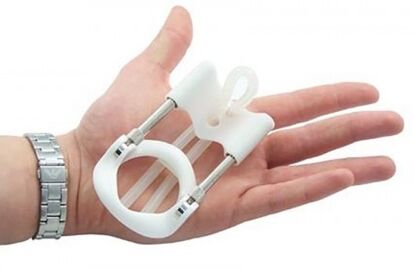
Among all known methods of increasing the size of the penis, the most effective is its surgical correction.Other methods either do not give results (miracle ointments, compresses, dietary supplements) or give a short-term effect (vacuum pump - one-time use, injection - up to 12 months + possibility of side effects).A conservative method is to use a special device to lengthen the penis, an extender that exposes the soft tissues of the corpus cavernosum and blood vessels to gradual tension, but it should be worn for a long time (more than six months) without surgery.
Ligamentotomy of the penis is a relatively simple phalloplasty operation that allows to increase the length of the normally functioning reproductive organ.
The surgical intervention consists in freeing the inner part of the penis shaft hidden in the subcutaneous fat by cutting the cartilage-like ligament that fixes it to the pubic bone.The restriction removed in this way allows to extend the genital organ by 3-5 cm.After surgery, traction devices are used to prevent the ligament from sticking to its previous position along the cut line, but for a shorter period of time than with conservative treatment.
Ligamentotomy of the penis allows to change the physiological parameters of the penis for life.This has a positive effect on a man's psycho-emotional sphere and sexual life.
It is estimated that a total of 15,414 ligamentotomies are performed worldwide, with almost one fifth of these performed in Germany.
This operation is much simpler, safer and cheaper than a penile prosthesis, but it can be ineffective when a man suffers from severe forms of erectile dysfunction in addition to the small size of the male genital organ.
Indications
Ligamentotomy is performed only in adult patients and may be indicated for health reasons in pathological cases:
- congenital or acquired proliferation of the connective tissue of the penile ligament, which prevents the straightening of the erect penis and makes erection painful (Peyronie's disease);
- replacement of the cells of the cavernous tissue of the penis with connective tissue cells (cavernous fibrosis);
- micropenis, when most of its shaft is hidden in subcutaneous fatty tissue - the visible part of the erect organ is small in size, which objectively complicates sexual life;
- penile injuries;
- body dysmorphophobia - in the absence of more serious mental illnesses (if the length of the erect penis is 180 mm or more, the patient may be refused surgical correction) is a man's obsessive dissatisfaction with the size of the penis (anatomically quite normal).
Men who complain of a small penis despite being of sufficient length usually suffer from either penile dysmorphic disorder (BDD) or small penis anxiety (SPA).In both of these disorders, men consistently underestimate the size of their own penis and overestimate the average size for other men.
An indication for plastic surgery to increase the length of the male genital organ may be the patient's desire arising from aesthetic considerations (if there are no contraindications), for example, the visible length of the erect penis is less than 120 mm.
Preparation
The preparatory process begins with a consultation with a urologist who will examine the patient, find out the reasons that prompted him to apply for surgical correction and make sure that there are no diseases of the genitourinary organs.As part of the preoperative examination, the patient undergoes blood tests: clinical, glucose, biochemical composition, coagulation, blood group and Rh factor, syphilis, hepatitis B and C, the presence of HIV infection.He will first undergo fluorography and electrocardiography.
The list of preoperative studies can be expanded based on the presence of chronic diseases in the patient.
The patient will speak with the anesthesiologist, who will be warned that since the operation is performed under anesthesia, he should not eat or drink for the next eight hours to prevent asphyxiation by vomiting.
Pubic hair should be shaved before the operation.
Ligamentotomy technique
The actual surgical intervention involves cutting the superficial cartilaginous ligament that holds the penis in a certain position.This manipulation allows you to remove the penis from the womb without breaking the anatomical integrity.
When the operation requires the greatest release of the hidden part of the penile shaft, it is often performed openly through an incision made in the scrotal region (midline) or lower pubis.Typically, the approach is discussed before the operation and determined depending on the problem to be solved.
Modern operating rooms are often equipped with endoscopic equipment, in which case micro-incisions are made.
The classic method consists of cutting the ligament and stretching the penis to a certain length (depending on the length of the hidden part of the shaft) up to 25-50 mm.Suturing and fixation of stretcher-extended body.
A more modern method involves the use of the patient's fat from the areas harvested during surgery.Fat is placed in the cavity of the torn ligament (lipofilling), which promotes tissue healing and prevents adhesions.After that, a stitch is applied.The second type of intervention takes a little longer.
Complete release of the corpus cavernosum from the pubic ramus is associated with a significant risk of disruption of the neurovascular connections of the penis, leading to denervation and devascularization of the penis.
The operation itself lasts about 30-60 minutes, the patient stays in the clinic for a day, but its success is facilitated by proper postoperative care, which is the second and necessary stage of penis enlargement.
Contraindications for implementation
The possibility of performing the operation before the patient turns 18 years old is not taken into account.
He should not have mental illness, bleeding tendency, genitourinary disease, malignancy or diabetes.
Surgery is not performed during acute infectious diseases and/or exacerbation of chronic diseases in the patient.
Results after the procedure
Genital functions (urination and erection) are usually completely preserved after ligamentotomy;muscle tissue, ligaments and vessels responsible for these functions are not affected during the operation.During ligamentotomy, lymphatic drainage should not be disturbed, because if the operation is performed correctly, the lymphatic vessels should not be damaged.However, mild swelling and bruising are possible in the surgical area.Passing through the scrotum is easier to tolerate, the suture heals faster, but the incision in the pubis is more often complicated by hematomas and swelling.
The result of the use of general anesthesia is drowsiness, and impaired coordination of attention usually disappears within 24 hours, even in the most sensitive patients.
Post-procedural complications
Paradoxically, the main side effects of this procedure are relapse, shortening of the genital organ and lack of support for the genital organ during erection, making intercourse and penetration difficult.
Complications are certainly possible after the procedure.Again, this is a transaction.If unwanted results occur, you should consult a doctor for advice on taking the necessary measures.
Closure of sutures is a normal process after ligamentotomy.The resulting scar is always tight;then it softens.Stitches heal in about three weeks.For some it is earlier, for others it is later.
Sustained sutures indicate bacterial infection, and "infection during surgery" is not important.Perhaps the patient had a chronic infectious process.The infection is usually treated with antibacterial drugs.You need to see a doctor to prescribe them.
Plaques should not be visible after ligamentotomy.They are surgically removed during this operation, which cause the curvature and pain of the penis.This is the proliferation of fibrous tissue in the tunica albuginea of the cavernous bodies.The main reason for their formation is the microtrauma of the penis (usually during sexual intercourse), which is expressed by the development of microhemorrhages, and then areas of connective tissue are formed in their place.If plaques appear again, first of all, you should consult a doctor, and secondly, you should think with your doctor about what caused their appearance.
The scar after ligamentotomy can be well seen, as postoperative scars are formed during any operation.Over time, they become softer and separate.Much depends on the quality of the patient's skin and the skill of the surgeon.Physiotherapy and other methods are used to eliminate postoperative scars.If the scar bothers you a lot, you can consult a doctor about it.
Post-procedure care
Analgesics can be prescribed to relieve pain in the postoperative period.Bandages are applied every 2-3 days, sutures are usually removed 14 days after surgery.It is recommended to abstain from sexual intercourse for 1-1.5 months.
The mandatory post-operative stage for any type of operation is first to wear a stretcher (for the first three weeks, sometimes longer), then a stretcher;without it, the operation may be pointless, because the ligament will heal along the fracture line and the penis will return to its original position.In addition, the extension of the genital organ allows it to be extended by an additional 15-25 mm.
The minimum period for wearing the expander is two months.It is worn only for one to two hours in the days after the operation, and then for six to eight hours every day.Make sure you take it out at night.
The ligament heals under the influence of a stretcher, but not along the cut line, but in a stretched position.The presence of the patient's own fat in the incision space helps in rapid tissue granulation.
You should extend your penis gradually, carefully, avoiding pain and strictly following the doctor's recommendations.Only a slight tension should be felt.
Reviews
Opinions about the operation differ.Some complain of complications, hematomas and fever.Basically, such complaints are characteristic in the early postoperative period and should be addressed to a doctor.Each body is individual and stitches need at least 10-14 days to heal.
The results of ligamentotomy were not always favorable.Patient and partner satisfaction levels range from 30-65%.On average, the operation increases the resting length of the penis by 1-3 cm.Low satisfaction rates make this surgical technique unaffordable for many patients.
In addition, questions are often asked about whether it is possible to lengthen the penis and increase its thickness at the same time.This is not recommended.Experts advise to perform a ligamentotomy first, and only after stopping all measures to increase the length of the penis, using an expander that tightly squeezes the organ, increasing the thickness of the penis is unacceptable, you can proceed to the next stage.